
reflections & fragments (VI)
on cynicism, modern-artists, & dreams

Cynicism and compulsive criticism are poisonous to the spirit when used as primary modes of expression.
For most intelligent people, this is the default mode of operation, only because it is much easier to use one’s intelligence to dismantle than it is to create (which is to bring beauty, new ideas, new modes of being and thinking into a world that desperately needs them, as opposed to pointing out why everything is wrong).
The irony of my own criticism here is not lost on me. Maybe it is an impossible urge to resist in a post-postmodern transitional world.
But if the gate toward creation is narrow, then the broad path is destructive.
It’s true, as we know, that social crucifixion awaits those who walk the narrow path.
Those who defend their position purely from pride will say that cynicism is a facet of intelligence — formed from a certain degree of knowledge or experience, which may be true, but it is not the final destination.
If all humans are born with intuitive intelligence, and others “graduate” to a high-cerebral intelligence, leaving intuition behind, then either without the other is a vacuous existence.
The world is not in need of more or less vitality / intelligence. It is starving for those who can harvest both.
The main difference between public figures (particularly artists) now and in the past is that, previously, an artist had to prove their competency of craft: their talent, their masterfulness, before the persona as a public-facing entity followed. Michelangelo, for example, sculpted the Pietà at 24, and only later would become the archetype of the tortured, divine genius, which served to advance his fame. Or, David Bowie, to use a more modern example, who, though his career was defined by a fluid and ever shifting persona, was first an incredibly gifted composer and musical talent. The combination of these two things (talent and persona), which together create the formula for fame, is very much still the same. Only now, the equation is reversed.
Now, in a world fully entrenched in pop-culture and algorithm dynamics: talent comes after persona. This creates a society with a high tolerance for mediocrity, redeemable by the spectacle of persona.
YUNGBLUD, the musician, is one great example of this.
Dreams are only a “random assortment of images” when held under the scrutiny of logical conscious thought.
Dream analysis, through a conscious-logical lens, is like trying to interpret a foreign tongue strictly through the lexicon of your own native language (labeling every word you do not know as “gibberish”, instead of recognizing that it may carry its own meaning independent of your vocabulary).
Dreams, in fact, are a foreign language: something to be decoded and understood.
People, places, and objects in dreams are symbolic stand-ins; representations; containers of the psychic undercurrents that rule our waking lives. They reveal to us our true relationship with reality in a way that conscious logic cannot.
All attempted dismissals of dreams as “nonsensical” are based purely on scientific explanations for how dreams arise (random neural signals, memory consolidation, etc.), but it cannot explain why certain images recur, or why dreams organize themselves symbolically. It does not explain what is hiding in plain sight: that we are afraid of listening, for fear of what those repressed truths might hold.
Denial through realism becomes the rope-in-the-water we hold onto, something that links us to the physical realm as we’re dragged around the vast ocean of the psyche.
Cutting the rope, however, is not the answer. It is learning to swim. It is the willingness to swim. Like a child beginning to paddle: starting first shallow, gliding further out the more experience they gain.1
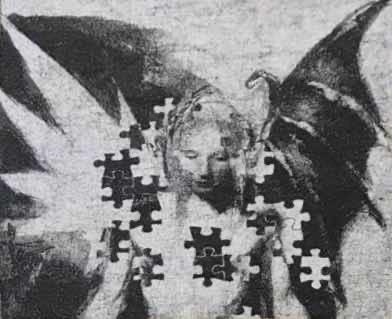
Have we mostly lost the ability to interpret symbols, to consciously sit with a piece of art that requires effort to understand but transforms us? Have we drifted so far, from active-interpretive engagement, into passive consumption?
For every authentic and organic group of people, there is a mimetic-aestheticized version of them (which is separate) that is hollow and superficial.
This is true across every subculture.
The authenticity of a subculture is often marked by having not been named, therefore, having not been organized into a cohesive scene (in the aesthetic sense).
But once the capitalist machine and its media gets a hold of it, it ceases to exist in its organic form.
British Punk, as an example, evolved from its natural circumstances: poor, working class urban kids in gritty neighborhoods — products of a growing economic divide, rebelling (whether consciously or unconsciously) against the bourgeois system that displaced them, bearing nothing short of hatred for the products and culture it produces.2
Now, it is a uniform. A style. An aesthetic. Even the ethos of punk has been co-opted and sold back to us.
Grunge is another example. If you can buy pre-ripped jeans, and shirts with holes in them for hundreds of dollars from luxury stores, then that subculture in its authentic form is long-dead. Once a subculture has been exploited by commerce and adopted by the mainstream, its body remains, but its soul collapses. It becomes like a painted shell: aesthetic but hollow.
People build resentment much more online, especially toward individuals who they might otherwise like in-person. I’ve been a victim of this myself, both as the perpetrator and the object of resentment. Social media, when used to express oneself (particularly through language) represents the way we think when we’re alone; it doesn’t take into account aspects of emotional personality, body language, or nuances in words and the intentions behind them. Social media, in a way, is a vehicle to impose your individual and idiosyncratic way of thought onto another (to receive confirmation and validation of your individuality), and it is therefore easily (and often) misinterpreted as a rejection of (or an attack on) the viewer’s own individualness and idiosyncratic way of being. In-person activity, which is an inherently more collective activity, creates a more stable environment for disagreement. In-person, you may disagree with someone and still like them very much. But, on social media, one may believe themselves incompatible with other types of individuals, since all nuance and subtlety are lost, and individualness is expanded and amplified. This is what creates the intellectual danger of online echo chambers. Echo chambers, in turn, crystallize into ideologies. Ideologies, when brought to their natural limit, breed violence and inflict collective suffering.
CURRENTLY READING:
Bohemians: A Very Short Introduction (Oxford Academic Series):
A book I picked up from E Shaver Books while traveling through Savannah, Georgia — on my way up from Florida to New York by train. I’ve only recently discovered this series: “A Very Short Introduction”, with hundreds of books covering various topics across the series. 100-150 page booklets covering a singular interest with surprising depth. I’d liken it to reading a more informed, specialized, longer, but more stimulating wikipedia page on any given topic. I’ve always been interested in the concept of Bohemians (artists living on the margins, impoverished, and often nomadic due to their living-by-the-art lifestyle and refusal of bourgeois values), both historically and socially. Most of my interest comes from the fact that, in my late-teens through mid-twenties, I lived this lifestyle, before having a name for it.
Scenes of Bohemian Life – Henry Murger (New English Translation, 2023)
Naturally, this was the next step. The origin of the bohemian myth. Episodic fiction. Not quite a novel. Fragmentary micro-stories following a troupe of Parisian bohemians as they write, paint, and compose while scrounging up anything they can for food, clothes, and shelter — often moving from place to place outrunning their debts. Written in 1851, translated from French: the first English translation since the 1940’s. The thing that’s surprised me most about this book is how much of an impact the bohemian myth in general has had on western culture, but how little Henry Murger is remembered or acknowledged by that culture itself. His name, at least in the Anglo world, is soaked in obscurity. Yet, his contribution is solely responsible for the “starving artist” trope that still persists (romanticized) today. Apparently “Rent (The Musical)” is based on a popular 1896 Italian opera called “La Bohème” by Giacomo Puccini, which in-turn is based on the stories from this book. It seems that when a concept becomes so embedded in culture, it ceases to be a product of culture and simply becomes absorbed into culture itself — this is where the individual loses credit, and the culture at large gains recognition.
The Society of the Spectacle – Guy Debord
Dense aphoristic writing on the concept of “the spectacle” — the modern condition of mass media, its malicious nature, and the culture of consumptive-distraction it induces (sedation of the masses via “the spectacle’s” self-sustaining comforts). Written in the 1960s but eerily relevant when considering “the spectacle” of social media and its detrimental effects on society (when taken past its useful limits).
But the psyche has its depths. It is only by venturing too far, losing sight of the rope entirely, that we risk being swallowed.
“Hippie culture” — ie: peace, flowers, and love being among those co-opted products, which, starting organically as a legit counter-culture, eventually became the antithesis of counter-culture itself (once the culture started being sold). This, in part, is what punk rebelled against, becoming eventually a victim of the same cycle.
I LOVE THIS!
'Grunge is another example. If you can buy pre-ripped jeans, and shirts with holes in them for hundreds of dollars from luxury stores, then that subculture in its authentic form is long-dead. Once a subculture has been exploited by commerce and adopted by the mainstream, its body remains, but its soul collapses. It becomes like a painted shell: aesthetic but hollow.'
Reading your pieces makes me feel like Im getting a healthy dose of inspiration compared to the junk I inhale from social media! Don't stop writing these! :) Love the format!