
reflections & fragments (VII)
on emotion vs. intellect, spiritual holocaust, & the post-art world.

The goal of the hypermodern individual is to attain an excess of material provisions and status symbols that act as alternatives to meaning: weapons for fulfillment of a spiritual holocaust.
I
The transmitters of life into cultural expression, in today’s world, are the feelers, whereas up until the second half of the 20th century1, it had been the thinkers. The reason for this is simple: we no longer believe that thinking can spare us from suffering. Two back-to-back world wars had completely shattered the religion of thought; it was clear that intellectual systems had failed us. But the contemporary belief that we no longer possess the faculty for critical thought is false. The truth is much more sinister: that the need to understand has been replaced by the need to forget (or evade) the opacity of living. Escape into emotion rather than out of it. The dark merchants of the world know this well, and exploit it. Emotional immediacy then becomes the default mode — the only understood path to expression. That is why modern art (film, music, media) reflects only the immediate senses, refusing to transmute emotion beyond catharsis. Because emotion is the great equalizer of thought. Thinking, then, becomes a privilege of the elite. Not because society can’t think, but because it won’t. And this discrepancy is exactly what maintains a power balance.
II
The inability of the feeler to discipline their impulse and direct emotion toward logical faculties is parallel to the deficiency of the thinker to engage spontaneously with the senses and to experience instead of analyze. The ‘power balance’ I speak of, one where the thinkers systematically dominate the feelers, would be more accurately defined as an imbalance. A true balance should be total: two parts working in tandem, instead of a bifurcation. All of the great esoteric religions and philosophies across time teach the alignment of two opposite poles (Daoism, Gnosticism, Hermeticism), but history teaches us that, on a collective level, it is an impossible ideal.
III
In practice, this ‘alignment’, or individuation, as Jung called it, is really only possible on an individual scale. Bringing the various parts of the psyche into the conscious realm is one thing, but to conquer the divide, to become a perfect whole is another. I’ve suffered the consequences of the feeler with all of its impulses and chaos an entire lifetime, and it has been both the source of my soul-song and the harsh silencing of its rhapsody. I know its beauty and also its deformity. Its rapturous summits and its disquieted valleys. But most of all, I know the limitations it carries. So I’ve thrust myself into the life of the thinker, with all of its structural hierarchies, and I feel the heat of the all-consuming blaze cool away, and this becomes my refuge. But here I lose something dear. And I cannot retrieve it without paying back lost time. I know where it lives in me; I hear its melody humming in the distance, plotting my seduction. And in my frequent moments of frailty, I acquiesce, letting it wash over me and take control. In two weeks I lose two years. But what the thinker preserves in years, it takes away from the spirit of living. So I vacillate endlessly between the two, the thinker and the feeler. Until I can reconcile the gap. Until I can become whole.
IV
“The language I speak must be equivocal, that is, ambiguous, to do justice to the psychic nature with its double aspect. I strive consciously and deliberately for ambiguous expressions, because it is superior to unequivocalness and corresponds to the nature of being.”
— Carl Jung
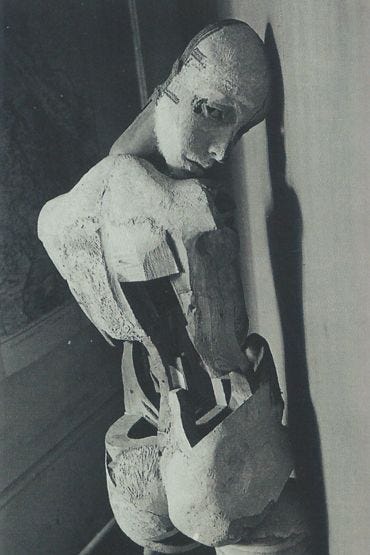
We are moving into a post-art world. Perhaps we’re already halfway there. The decadent forms of entertainment are only just beginning. Art, which alters the psyche and stirs the soul, unseating material comfort, is becoming a medium of the past. During the industrial age, art was already being relegated to novelty. In the digital age, novelty became entertainment. And now that entertainment is ‘art’, thinking has become a novelty too. Only, it’s a novelty nobody wants to buy.
Humor is the only expression of vulnerability that’s reflexive, cathartic, and lacking an element of shame.
In great art, it is a tool used to disarm the audience — to open them up to the sincerity underneath.
The difference between humor and irony is that one invites vulnerability. The other deflects it.
Often, it feels like a hopeless cause pursuing this romantic idealism, this philosophy of art as a vehicle for progress — not in the sociopolitical sense — but toward self-actualization. As an expression of being. A rebellion against the propaganda of doing.
Perhaps it has always been this way: an encampment of a few hanging on the fringe, clawing at the iron door, collapsing at the foot of the gate.
To some, their ghosts still linger. And a quiet revolution seeps through the slits: baptism of the individual spirit.
Not literally from the beginning of human history up until that point, but at least from The Renaissance forward.