
vanity as a necessity.
the dualism of artistic vanity.

On the outskirts of a small French village, a Dutch painter limps out across an open field. He unpacks his easel and places a blank canvas upon it.
Setting his palette between his left thumb and index finger, he mixes together various oils, aiming to reflect not the color of reality, but the divine state of his creative encounter.
For these few brief moments when the sunlight touches his hand, and his brush touches the canvas, he is in communion with God. He is a vessel. And his own creation is a manifestation of this transmuted genius.
This solitary engagement is his only respite, his sole recess from an otherwise treacherous existence.
There are no crowds or critics waiting to greet him when he is finished.
But under the current spell, he does not care.
Vanity, the conviction of one’s own self-importance, is as necessary to the artist as water is to the body, in nourishing the creative spirit.
Yet vanity alone is not enough to sustain it. Vanity alone, through its seduction and self-deception, disguises itself masterfully as something meaningful. But ultimately, it is empty.
We know this, yet strive to convince ourselves otherwise. We delude ourselves to the value in such vain pursuits as being an artist, defying the paradox and our greater intuition.
Having been born into the spectacle of the late-Western economic juggernaut, where all novelty is commodified, and the parts that make up an individual become assets to emphasize in the marketplace, we are taught the merits of personality which can be sold — not of creative excellence, but character marketability — which creates an internal value system that often excludes intrinsic or ethereal worth (which is the aim of the organic artist: the need to create, from a spiritual starting point, not social or material).
Largely, this influence is inescapable. There is no channel online or offline untouched by this Ouroboros of commerce.
Even the “art purist” mentality becomes a point of emphasis, a commodified identity, when held long enough under its light.
In that, vanity is inseparable from pursuing art in the modern world, in the professional sense.
One would have to hide away in a cave to escape its pull, away from where the tentacles of media could grasp it, preventing the insidious cycle of novelty > trend > duplication > saturation that culminates ultimately in that dreaded word which has been the death knell for all art: product.
But even those who hide away in caves are vain, just as vain as those proclaiming their genius from the edge of the mountain.
One is a spiritual vanity, the other, material.
An artist cannot create unless they believe in their own genius, in their intimate relation with the divine, the muse, “the spirit of creativity” — whatever you want to call it.
But once this spiritual vanity is revealed beyond the private monastery of the artist and their art, the spiritual element ceases to exist, becoming usurped by the material standard, where one must adapt in commodifying their vanity, or withdraw in disgust, back to the cave.
Spiritual vanity is a private delusion. A spiritual trinity formed between you, the creative encounter1, and your creation.
Like Moses being handed down the ten commandments, then handing them down to humanity himself, you must be vain enough to think yourself a vessel, to believe that something outside of you is working within you.
The other vanity, the material vanity, is unsustainable in the spiritual sense in that it begins or ends with the material objective, aiming to reflect the image of the encounter. But only the image.
For example, look at an artist like YUNGBLUD, who has built a career off fashioning himself in the image of punk (a movement with organic origins), but who lacks the original seed and innovation that birthed its spirit, co-opting the image as a promotional tactic to carve out market share.
In this commodification of the creative encounter, the audience takes over the sacred element that binds you to your creation, and creation as a separate entity is replaced fittingly by one’s relation to oneself.
Look at any ultra-successful popstar from any of the past several decades whose popularity exceeded their depth, whose legacies are simply that they were popular, with no lasting effect on the cultural psyche.
Such events can only transpire once the ethereal element of an art crystallizes into a material image.
The artists whose impact tend to resonate and proliferate throughout history always fall into one of three categories:
Those whose monasteries are revealed to the world posthumously (Van Gogh, Emily Dickinson).
Those who reveal themselves with later regret, whose sensitivity to exposure creates intense spiritual suffering (Rimbaud, Kurt Cobain).
And those who adapt to the material standard of art, whose excess of talent can only arise from the organic encounter (Shakespeare, Michael Jackson), but who’ve mastered the image of the encounter, from which it is impossible to tell the difference.
The inescapability of The Ouroboros is such that one could technically belong to the 2nd category as part of a marketed persona, while really belonging to the illusion of the 3rd.
Likewise, casting one’s lot with the 1st category in the aim of posthumous fame is not only foolish but belongs strictly to the material standard as well. E.g. the trope of the sensitive, reluctant artist-genius that’s so often played up, consciously or unconsciously, by known and unknown artists alike.
There are masses of unmarked graves for artists who’ve never touched the spiritual elements of encounter, seduced only by the material, or those who have only ever touched the spiritual, never adapting or flourishing in the material.
However, there are still many artists throughout history whose greatest contribution was their art itself, whose names are not remembered deeply, but whose work has been absorbed into the culture at large (Henri Murger and his bohemians, John Polidori and his Vampyre).
This is probably the purest outcome, but one whose result is not as appealing to our materialist vanity.
That is why total-vanity2 is both the starting point and the end point for the modern artist. He gets there through vanity, yet suffers spiritually at the hands of it as well, if he casts it into the material world.
When spiritual vanity is rewarded in itself as a trait, instead of relegated to its spiritual function, it ceases to be a thing of value to the process of creation itself, and merely becomes a facet in the product of personality, where the creation isn’t the end goal—but instead the validating element of the true product: individuality.
In this case, an artist becomes inseparable from their art. This is nothing new, however. Context always alters perception. Objectivity cannot truly exist under context. But only in the modern era have we collapsed into context as the primary marker, and creation as the secondary (merely a necessary circumstance, an accessory for context).
It is a system that rewards vanity for vanity’s sake.
But I say to you: do not stop being vain. Do not eschew the voice of your god as it speaks aloud to you in silence. Be vain enough to believe in your own genius, allowing its pneuma to manifest in reality.
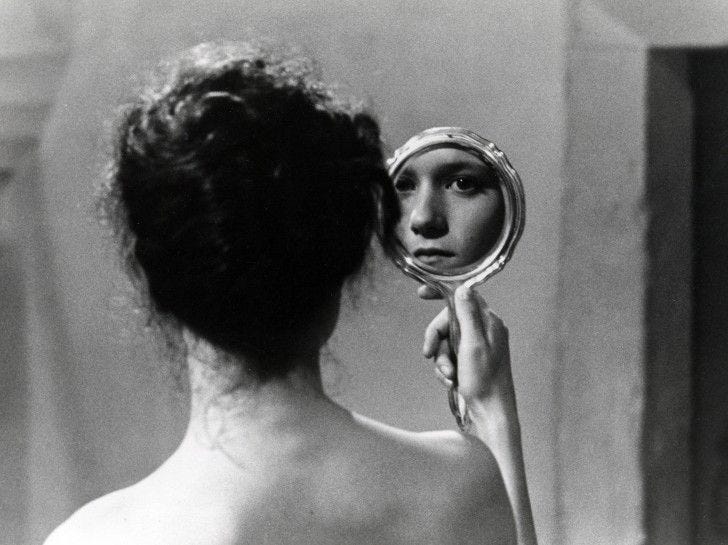
And when the mirror is held up to the gaze in completion, as the spiritual element decays, effectively ending the ritual, a new material purpose is gained.
And this dualism, this spiritual-material / push-pull cycle of creation, as modern artists, is our Sisyphusian task.
This is what gives our total-vanity meaning. What makes it necessary.
A woman on a beach in South Carolina dances along the shoreline. Her dress, patterned in the image of “The Starry Night”, flaps around in the wind.
Her nephew has the same pattern imprinted on a skateboard; a Christmas gift that’s casted away with all the other misfit gifts he’ll never use, stuffed under his bed.
It was quite an expensive and in demand product at the time.
Neither of them can pronounce the name of the artist correctly, or remember the name of the famous painting.
Likewise, neither of them care, but they like the way it looks.
A concept named by the American psychologist Rollo May, which he writes about in-depth in The Courage to Create.
As in the full, dual-sided nature of vanity, encompassing both spiritual and material elements.